精品人妻无码,国产精品亚洲专区无码web,国产成人久久久精品二区三区,国产亚洲成年网址在线观看,久久久久成人精品无码,亚洲日本人妻中文字幕,亚洲精品一区二区三区精品,色综合中文综合网,亚洲国产97在线精品一区,久久AⅤ无码精品色午麻豆

分享到:
中文 | English
Home>>Industry News
News
Industry News
Surface finish of thermoplastic composites is dependant on base polymer and processing conditions
  Release time:2021/6/16

Surface finish of thermoplastic composites vary and depend upon polymers. Both aesthetics and function of a reinforced thermoplastic part are affected by surface finish variables - the type of plastics being molded, the combination of additives specified and the processing conditions that have been set. Additives to be used in thermoplastic composites will affect the surface finish. Processing techniques also determine the surface finish. Surface finish characteristics of the many thermoplastic composites available vary among polymer families. 
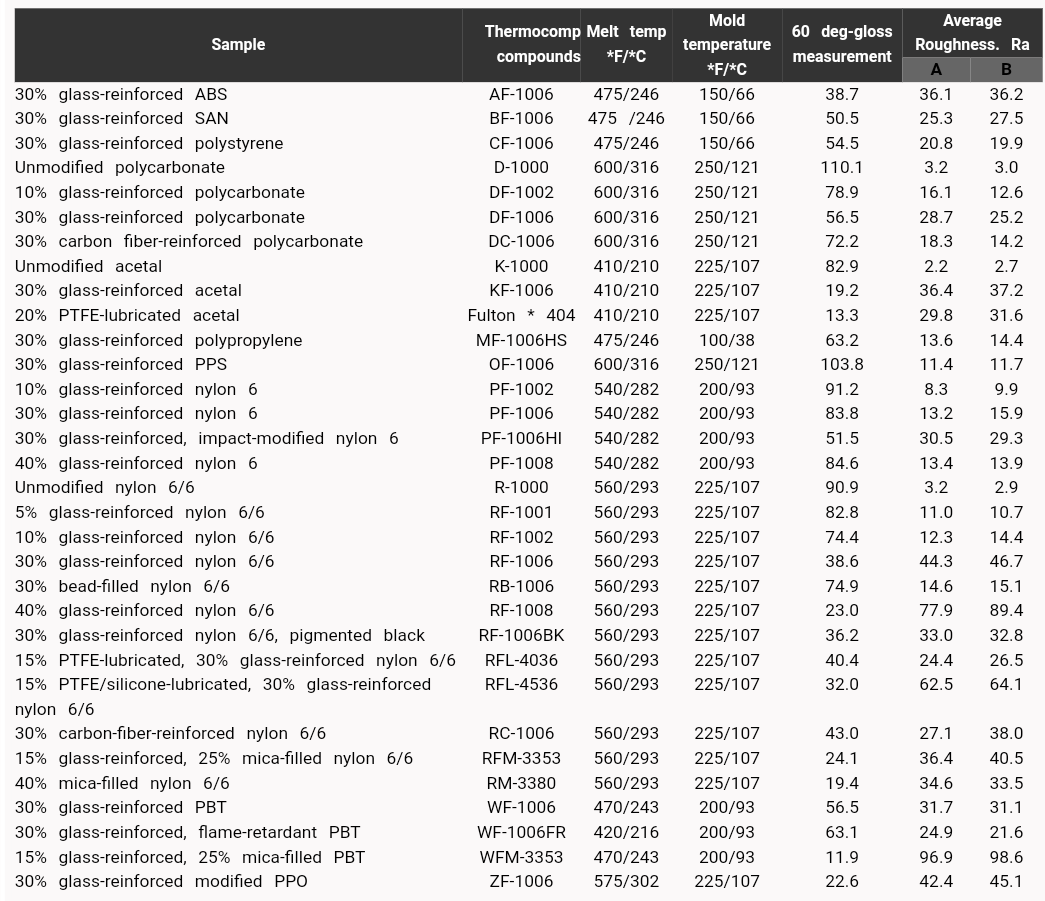
The part’s aesthetics and function come into play in choosing the optimum material. Aesthetics are important in such appearance products as business machines or power tool housings. Function is a consideration in areas where a good seal between mating parts is needed. Wear resistance and coefficient of friction are also affected by surface finish in both plastics-on-plastics and plastics-on-metals applications. It is possible to predict the influence of materials selection and processing conditions on the surface finish of molded thermoplastics composites by examining a set of amorphous and crystalline polymers. In a recent study by Sabic IP, gloss and surface roughness measurements conducted on these materials indicated definite trends when the results were analyzed in relation to the standard and variable molding parameters. 
Gloss or specular reflectance is the attribute responsible for the shiny or lustrous appearance of a part. It is defined as the degree to which the finish of the surface approaches that of the theoretical specular-gloss standard, which is the perfect mirror, assigned a value of 1000. For practical purposes, the primary standard is a piece of polished black glass given an arbitrary value of 100. 
Higher glass fiber content results in lower gloss. In a study by SABIC Innovative Plastics, low glass content materials gave excellent gloss and roughness readings, approaching those of the base polymer. 30% Carbon-fiber reinforced polyamide 6/6 PC are smoother and glossier than their 30% glass fiber reinforced compounds of the same polymers. Both 30% glass reinforced PP & PPS give excellent surface characteristics. Polyamide 6 composites exhibited the best overall gloss and smoothness, no matter what the glass-fiber loading. There was essentially no sacrifice in surface finish with these composites, even at fiber loadings as high as 40%.

The addition of carbon black, PTFE lubricant, mica beads and antimony oxide (particulate fillers in general) to fibrous reinforcements reduced surface roughness. It was also noted that fiber reinforced composites containing particulate fillers yielded lower surface roughness values than the analogous fiber-reinforced composites. A PTFE/silicone-lubricated, glass reinforced polyamide 6/6 composite exhibits a much rougher surface than the analogous composite without the silicone fluid additive. Silicon is possibly causing debonding in glass fiber reinforced composites. The 40% mica/glass fiber reinforced PBT material is much rougher and lower in gloss than the analogous polyamide 6/6 composite possibly due to the improved bonding between mica and a polyamide 6/6. 


Effect of processing variables 
Injection speed, mold temperature and melt temperature all have a significant effect on the roughness and gloss of molded parts.
Fast injection speed always yields a glossier and smoother part, no matter what the other molding parameters were. Filling the cavity as quickly as possible also helps minimize fiber orientation and enhance weld-line integrity. 
A consistent difference in molding was noted between reinforced amorphous and crystalline polymers. For the amorphous materials SAN and PC a high mold temperature is more important in obtaining a good surface finish than a high melt temperature. However, for the crystalline polymers polyamide 6/6 and PBT a high melt temperature is more of a factor in achieving a good surface than mold temperature. This difference between amorphous and crystalline polymers hold true irrespective of parameters were changed. The use of higher melt and mold temperatures in reinforced and filled thermoplastics did not increase cycle times as these materials were stronger and stiffer than their unmodified counterparts, and can, therefore be ejected from the mold at higher temperatures. 
In addition, composites have higher thermal conductivities, which mean that they cool faster than base polymers. A slow injection speed, low mold temperature and low melt temperature are the conditions that will result in the poorest surface texture. 
Designers should recall the following points : 
 • Gloss and surface roughness are related in that a glossier surface is generally smoother and vice versa. 
 • Both gloss and surface roughness are affected by resin type, filler type and loading and molding conditions. 
 • Particulate fillers exhibit lower average roughness than fibrous reinforcements. When they are added to fiber-reinforced composites they reduce roughness. Also, when used to replace a portion of the fibrous filler, particulate fillers reduce roughness at equivalent filler-loading levels. 
 • Silicone fluids act as a debonding agent in glass-fiber-rein forced materials, thereby increasing roughness. 
 • A fast injection speed will always improve gloss and roughness. 
 • Higher mold temperatures are more important for increasing gloss and reducing roughness in reinforced amorphous resins. 
 • Higher melt temperatures are more important for increasing gloss and reducing roughness in reinforced crystalline resins. 
 • For any reinforced composite, the use of fast injection speed in conjunction with high melt and mold temperatures will always give the glossiest and smoothest possible part. 


Print this page || Closed the window 
Product Tree
SHANDONG HYMAN TOPBON CHEMICAL TECHNOLOGY CO.,LTD.
COPYRIGHT 2012-2013 BY SHANDONG HYMAN TOPBON CHEMICAL TECHNOLOGY CO.,LTD. ALL RIGHTS RESERVED
Tel: +86-0533-7960686 E-mail: info@hymantopbon.com
五月婷婷久久中文字幕| 精品久久久久久久无码| 国产亚洲欧美日韩亚洲中文色| 久热这里只有精品99在线观看| 男男GV白嫩小受GV在线播放| 人妻 丝袜美腿 中文字幕| 国产区免费精品视频| 厨房与子乱在线观看| 又黄又无遮挡AAAAA毛片| 免费无码一区无码东京热| 91国语精品自产拍在线观看| 国产日韩一区二区精品| 无码人妻一区二区三区免费视频| 日韩一区二区三区中文字幕| 亚洲一区二区三区精品在线看| 玩弄放荡人妻少妇系列| 亚洲精品日本久久一区二区三区| 少妇高潮喷水正在播放| 国产美女在线观看| 天天摸天天做天天爽2020| 国产精品第一区| 欧美区一区二区三| 少妇内射高潮福利炮| 亚洲日韩欧美自拍他拍| 99精品视频69v精品视频| 亚洲精品美女久久7777777| 久久这里只有精品免费首页| 痉挛高潮喷水av无码免费| 亚洲中文精品一区二区| 免费人成在线现看视频色| 日本少妇视频一区二区三区| 美女又黄又免费的视频| 99精品国产在热久久婷婷| 国产做a爱免费视频在线观看| 精品久久久久久中文字幕大豆网 | 福利成人午夜国产一区 | 人妻少妇久久精品一区二区| 免费jlzzjlzz在线播放日本| 永久免费AV无码网站YY| 亚洲精品久久久av无码专区| 国模欢欢炮交啪啪150|